I’m happy to share this new essay, published on 8/24 in The Memoirist, on Medium:
Every few months, a book arrived in my mailbox. First, the Ya-Ya sisters. Next, a later-age memoir, a treatise on seizing love and independence. Crinkled at the edges, the paperbacks followed what my mother didn’t send but quoted from, often, those first few years. Widowhood. By Dr. Joyce Brothers.
“She says I shouldn’t move to Paris.”
My mom, in a sad instant, had time to read. My brother and I were in our early thirties. She had retired from teaching eight-year-olds, a career that for three decades bestowed order and deep friendships. A sisterhood to rival the Ya-Yas. I don’t recall her sitting with a book when we were still at home, her leisure time co-opted by marking spelling tests, sewing skirts, stocking the fridge. Catching up with Dad in the den after dinner.
She’d tell me on the phone that the book was on its way, and she’d say why it was a good one. Not knowing her as a reader (of anything besides my magazine and newspaper articles), I liked hearing her analyses, seeing her in the academic slot that my father had occupied. Often, she made thematic comparisons to my life’s concerns — your marriage isn’t all bad; you’ll have the babies, don’t worry. Sometimes, she said that the writing was gorgeous. Sometimes, she just appreciated the tale. “I love a good story.”
When the Kindle was invented a decade or so later, Mom was intrigued and eventually bought one, her life having become a bit itinerant. Time split with the seasons, visits with friends, with suitors. She chose a violet case. She learned how to “make it go.”
Soon, she was reading The Times on the screen. She ordered books with a click. She raved, insisting that I get one, too. For the carpool line. Or the soccer field. The babies had come; she was right.
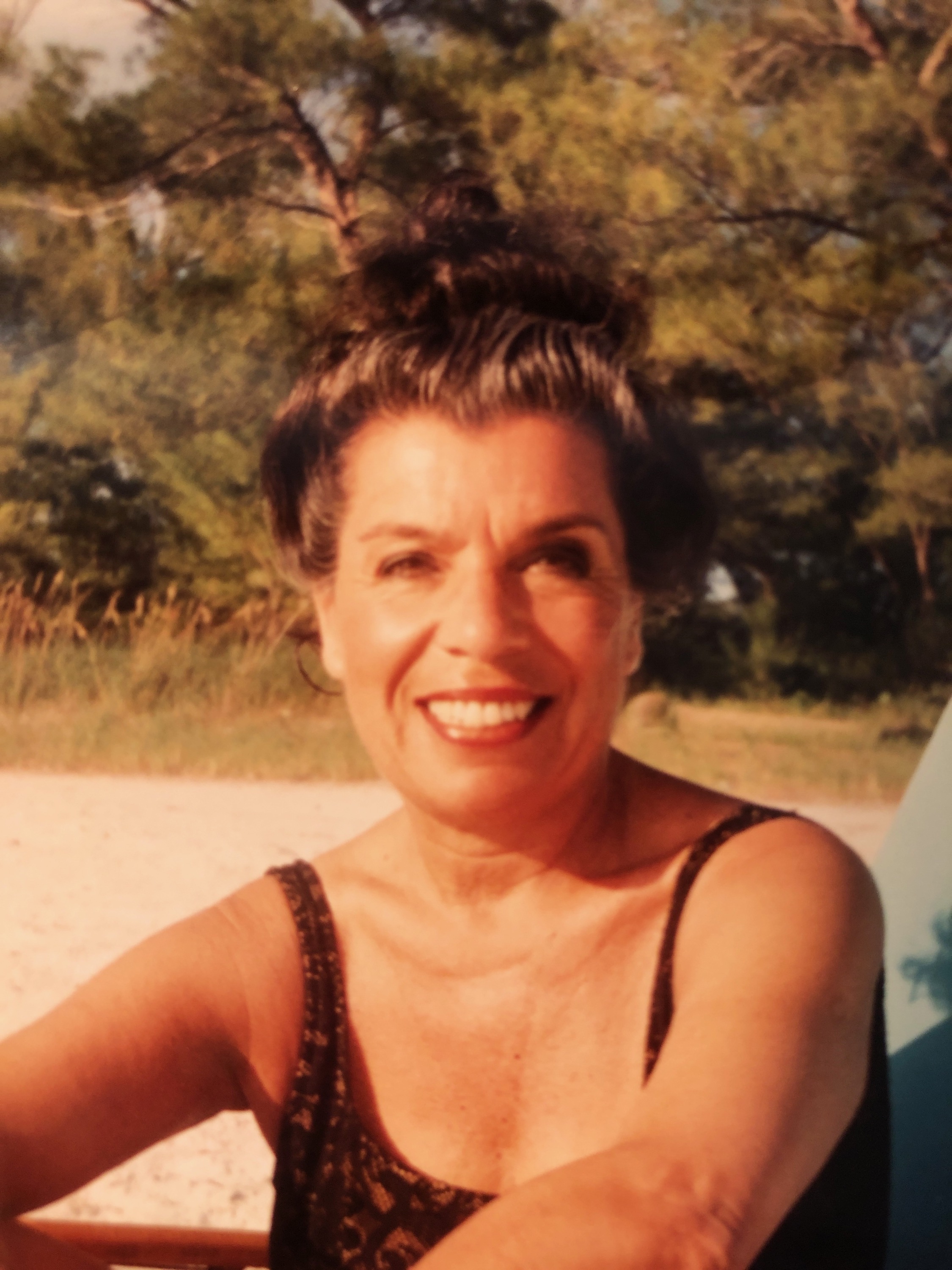
My mother never remarried, though she has rarely lacked companionship in the 30 years she has been on her own. She has certainly seized love and independence. But two years ago, when she was 86 and showing signs of memory loss, my brother and I convinced her to move closer to us, to give up some of that self-sufficiency. We packed her wedding china and velvet throw pillows — and her Kindle — and arranged a new life for her that would include grandkids, dogs, holidays and us.
Quickly, I saw what I hadn’t seen in the two years that the pandemic kept us apart. She laid out her monthly bills on the kitchen counter, attaching handwritten instructions to each, waiting for me to help finish the task. She couldn’t operate the CD player, even with the tags I taped onto the buttons, numbering the steps. She put eight cups of water into a six-cup pot. She stashed the Kindle in the night table drawer.
After seven months and a bout of Covid, she stopped walking, thinking she’d tip over. Some of what she said made sense; some didn’t. She stared blankly at two-dimensional images, seeming not to know what they were. Landscape paintings in the art magazines I brought from home, photographs of my daughters. Representations on a page — letters, words, sentences — were out of grasp.
Each time I visited, my eyes latched onto the things, the objects that surrounded her, categorizing them. These still have a purpose — the eyeglasses, the plates. These don’t much matter — the shoes, the retinol lotion. These she can no longer use – the hair dryer, the toaster. The Kindle.
My mother has been generous, with her time, her devotion to our lives, her things. When she flew to see me in Mississippi, where I’d taken my first real reporting job, she concealed an entire roast turkey in her carry-on. What aroma? she questioned her fellow travelers as they sniffed for the source. After a visit to her apartment when we both lived in New York, she’d send me home on the bus with plants and necklaces and muffins and belts, stuffed into bags that hid me in my seat. Open any cabinet in my home now, and some gift, some something that she believed I should have, peeks out.
Lately, I’ve been reading more books, having had two published, and though I’m a physical page purist, I’ve wondered what the screen experience would be like. One day, I took my mom’s Kindle from its drawer by her bed, thinking I’d ask if I could try it. I thought that maybe I’d hold it in front of her and see if she’d respond, if she’d look up from her wheelchair or lift an arm. To take it without asking would have felt unseemly. But before I turned to face her, I put it back, next to the box of latex gloves, the body spray, the unfamiliar barrettes that the aides clipped in her hair. I don’t know if my mom realizes that she can’t make a decision or express an idea. That she can’t read or select a ruffly top from her closet or do her eyes with the taupe shadow. Or sing along with Barbra Streisand. Or tell my daughters to choose wisely. I don’t know if she can look at herself in the mirror and comprehend her current condition or know that it is she whom she sees, even. Or know what used to be. I hope to god that she can’t know that. So, I couldn’t ask her if I could try the Kindle. I couldn’t ask her anything.
Since my first article appeared in the high school newspaper, my parents championed my work. They could have run a Public Relations firm with how effectively they disseminated my writing. In the last few years, my mother was certain I’d be an author one day. “You just need one olive out of the jar,” she told me.
One Sunday, my brother shared news of my first book.
Mom stared at us, appearing confused. I didn’t give her the copy I had brought in my bag, fearing it could inspire more agitation than pride.
As children, we know that our parents will miss a lot when they’re gone. We just hope they don’t leave before the good parts. My father never met my daughters. And now this, another milestone.
I know that my mother would insist I have the Kindle. She would tell me not to be ridiculous, never one to duplicate what we already had in the house. We had one electric typewriter, a hall phone with a long cord. She’d tell me she’d be happy it didn’t go to waste, that I made good use of it as I had the blue and white dishes and the tall-back chair from the living room, though she preferred her upholstery to mine.
I visit each week, mostly at lunchtime before she falls asleep. I help her hold a sandwich, if she can that day. I make sure she has extra ice cream. Usually, I’ll have brought something — soap, banana bread, a new shade of nail polish. Sometimes, she smiles at me; sometimes, I think that she does. Sometimes, she makes an expression that I recognize, and I hear the words that may have accompanied it. Not to worry, sweetie. Or, What a kid! For a speck of a moment, I feel as if my mother is with me.
I think about the Kindle again, several months after leaving it in her drawer. This time, it strikes me differently. It feels like more than an object I could switch on and use. I sense that it could reveal what my mother wanted to know at certain times in her life, where her thoughts and emotions wanted to go, how her brain chose to work. It feels like something to preserve.
After our next lunch, I wheel her into her room and wash her hands with a towel. I find the Kindle in the nightstand and tell her that I’m going to take it home, for safekeeping. We sit in her little living area, and I lean up against her velvet pillows. “I brought these for you,” I say, pulling out two books from my bag and holding them on her lap. “These are the ones I wrote. Look, Mom.”
She doesn’t take them from me or trace a finger over our last name or widen her eyes. She doesn’t touch the books. She doesn’t become agitated. It is too late for that, too. It is too late for all of it. I knew, but thought, maybe. I stack the books on a table, next to a tray of my grandmother’s, a glass flower from our living room, a photo of Mom and Dad. Dressed up. Heading out.
Back at home, I charge up the device. There’s A Tree Grows in Brooklyn, about a place my mother knew well as a child. There’s An Oral History of Late Night with David Letterman. Can’t figure that one. Then, The Fifties, her teen years, partly read. Perhaps not much to learn. And, Fifty Shades of Grey, completed, and a few pages later, Book Two, read to the end as well. Love and independence, in overdrive. There are also my essays, more than 50 of them, jumping out in gray and black.
The Kindle is dusty from lack of use. I clean the screen, the crevasses, the violet cover. It has felt like a visit. It has felt like a conversation. “Use it, sweetie. Don’t be silly,” I hear her say.
It has felt that I have. I turn off the power and place it safely inside a drawer.
Pamela Gwyn Kripke is the author of And Then You Apply Ice (Open Books, 2024) and At the Seams (Open Books, 2023). She has written for The New York Times, The Chicago Tribune, Slate, Salon, Elle and many other newspapers, magazines and literary journals.
 Pamela Gwyn Kripke
You are so good!
Dear Pammy, So beautiful. You are so talented. I cried and cried and cried. And I am still crying. Love, Jimmy
Very touching. I wish your mother could read your words.
Best wishes.
Thank you for reading, Jaya, and for writing. I really appreciate it.