PRAISE FOR AND THEN YOU APPLY ICE
Cleaver Magazine
Ashlee A. Paxton-Turner, August 2024, Click here
One of the most basic aspects of humanity is pondering the future—questioning who we are and what we will become. In the mid-1950s, Doris Day answered the question quite simply: “Que sera, sera / whatever will be, will be / the future’s not ours to see.” Decades later, Pamela Gwyn Kripke, in And Then You Apply Ice, provides a glimpse into the future that isn’t ours to see in twenty-one well-crafted stories about women and who they do indeed become. In this thoughtful collection, Kripke not only confirms that whatever will be, will be; she also offers compelling and accessible insights about the human interactions and relationships that tend to comprise various stages of life.
Throughout this richly developed collection, women repeatedly come to terms with what their futures hold as they confront the tension between loss and connection that is unavoidable in human relationships. Women face the mental illness of their partners (and would-be partners), the death of their partners, the loss of their parents, the inevitable age-related changes in familial relationships, and the potential loss of their children. Part of what makes the collection such a powerful read is Kripke’s ability not only to cover the experiences of women from girlhood to motherhood to widowhood in one volume but also her ability to highlight the particular questions about human connection and how those connections do or don’t define us as they surface throughout the various life stages.
Kripke judiciously uses recurring characters to encourage the reader to anticipate connections that aren’t certain and won’t always exist. Most of these stories leave open at least the possibility that a character is one that the reader has previously encountered in the collection. But because it isn’t always explicit, the reader must engage in a little guesswork. This guesswork allows Kripke to emphasize that connection can be fleeting and uncertain in a way that is itself interesting and unexpected. In doing so, she not only showcases her own talent for describing and building anticipation but also showcases how the structure of a short story collection can deliver its own narrative. Kripke’s structure is, in many ways, an invitation to the reader to reflect on the arc of the stories–something not all short story collections so graciously offer their readers.
Where the recurring characters are obvious, Kripke gives the reader the chance to catch a glimpse into how the future can change. For example, the bride in “Dress for Success” is also the daughter in the opening story, “The Suitor.” In “The Suitor,” Kripke has carefully and expertly contained loss and connection in one human interaction. Specifically, the story is largely told inside one fleeting moment—the moment before the daughter shakes the hand of her widowed mother’s recent suitor. In fact, this story is an emblem of Kripke’s talent for making small moments and details shine with narrative force. In the story, the daughter notices dirt under the suitor’s fingernails and considers how very different he is from her now-deceased father. In the face of her mother’s new potential connection, she faces the dissolution of her own marriage and the reality that she has lost her father. “Dress for Success,” precedes “The Suitor” in time but not in the collection. There, as her father gives her away to her husband, a young woman faces the promise of her own connection to her husband. Although the reader already knows her future by the time “Dress for Success” appears in the collection, on her wedding day, the bride does not. In this clever ordering, Kripke reminds the reader that for the individual in the moment, the future is not hers to see. And indeed, it is clever ordering like this that makes the collection engaging and a testament to Kripke’s ability to keep the reader in a state of anticipation rather than well-settled familiarity.
Throughout the collection, Kripke highlights that we often discover who we are and what we want in the most ordinary situations. And what could be more ordinary than what we eat for lunch or a late-night snack? Kripke repeatedly uses food to set the stage or move the story forward. In “Of All Things,” eating a turkey sandwich and with “coleslaw spill[ing] from his lip,” a husband tells his wife that he was suicidal when she said she didn’t love him. His wife’s initial reaction is to ask him how he would have done it—as she takes a bite of chicken salad, appreciating the addition of tarragon that she can never replicate when she makes it herself. In covering the various life experiences of women across different life stages, Kripke is a master of transforming the fundamental, day-to-day aspects of life into stories with sharp observations about human interactions and relationships. What makes the stories powerful is Kripke’s ability to transform details about numerous prosaic moments into mechanisms that reveal the sometimes-overwhelming feelings about those interactions and relationships.
When Doris Day poses these same impossible questions about the future to a sweetheart, she asks if the future will hold “rainbows day after day.” Kripke’s stories would tend to suggest that the future is anything but rainbows. Instead, Kripke offers raw honesty through women who confront the future with on-again-off-again partners and men who see them as objects or projects. In the title story, Kripke describes the relationship of Jane, an abstract painter, and Stan, a doctor, who specializes in removing fat. As the story opens, we learn that “Jane was thin, 105-pound thin, but [Stan] found the places where the flab collected.” When Jane wonders if Stan jiggles her flab the same way that he does that of his patients, she appears to be questioning if her future is really with this doctor or if she is simply another body for him to improve. Later, when Jane observes one of Stan’s procedures, her suspicion is confirmed, despite Stan’s earlier denials. As Jane watches Stan determine “where to correct the imperfection” and “where to eradicate the flaw,” she feels dizzy and runs to the bathroom—stripping down and splashing cold water on herself. After all, learning who you are to someone else and what, in fact, will be is understandably overwhelming.
Similar to how Doris Day concludes her song with the transition to motherhood, Kripke ends her well-crafted collection with a mother confronting the uncertainty of the future. In “The Holiday,” a divorced mother faces the possibility of losing her children, as her ex-husband has alleged that she is an unfit mother. The future is also not hers to see, but she can hold her children in that moment a little “closer and tighter.” The uncertainty of the future need not limit who we are and want to be in the present moment.
Doris Day’s famous song poses questions that are hard, if not impossible, to answer. In this collection, Kripke adds further gloss to the refrain of “whatever will be, will be” by demonstrating that, at the very least, the coming together and breaking down of human relationships will be a near certainty. Although this sentiment isn’t new, Kripke beautifully conveys it in a unique way that reflects the reality that the ebbs and flows of human relationships are not always expected in the moment and often contained inside the most ordinary of moments. It is hard to capture something so human in words in a way that is both believable and accessible, and Kripke has done it.
Ashlee A. Paxton-Turner is a graduate of the University of Pennsylvania and Duke University School of Law. She is currently a Visiting Assistant Professor at Duke University School of Law, where she researches and writes about corporations and American democracy. Her legal scholarship has appeared in a range of law reviews, and she has written several book reviews for Cleaver over the past decade. Before entering academia, Ashlee was a lawyer at a major law firm in Philadelphia and Washington, D.C.
PRAISE FOR AT THE SEAMS
Midwest Book Review
D. Donovan, Sr. Reviewer, June 2023
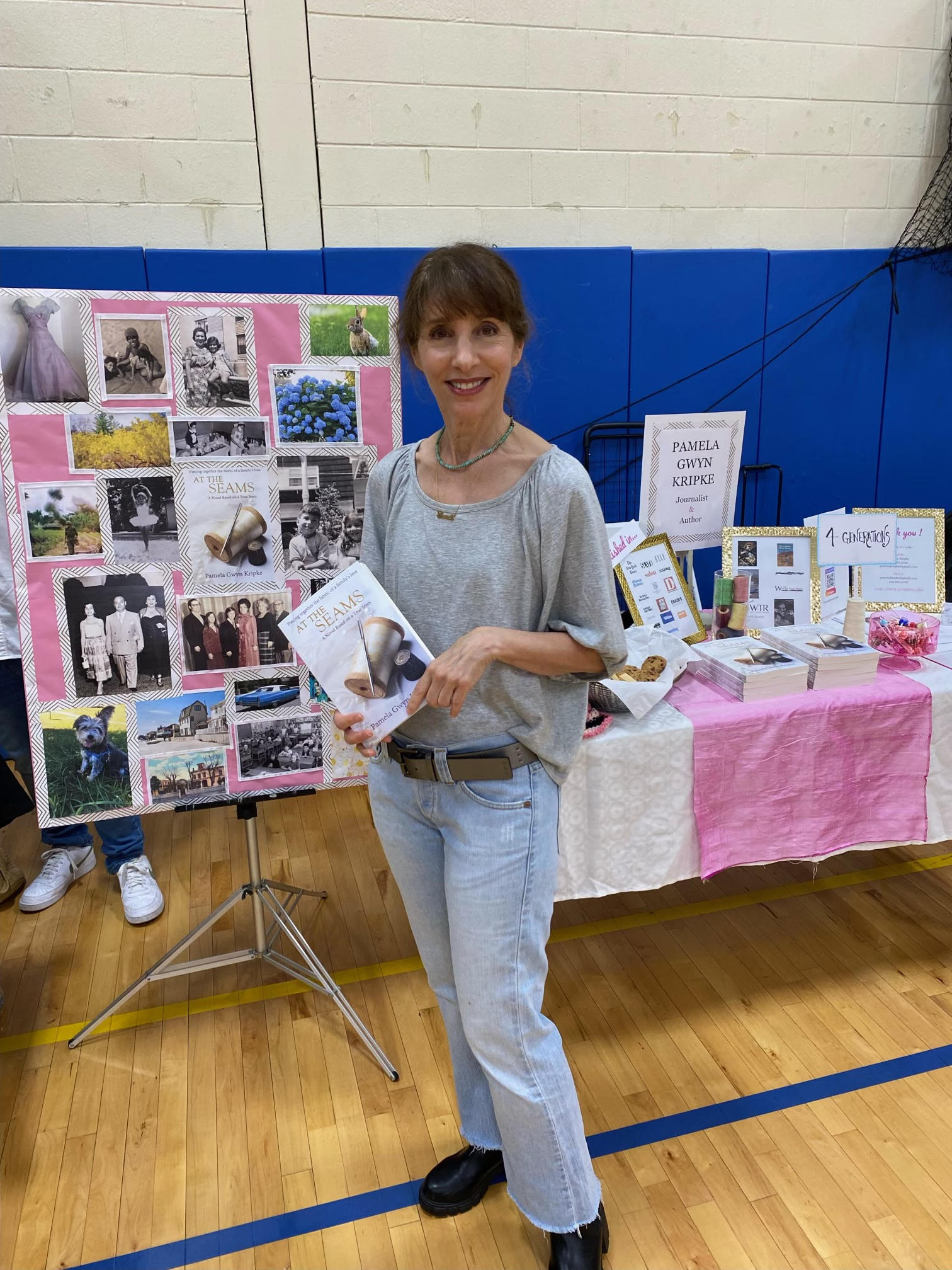
At the Seams is a novel of family loss that contains elements of pain and recovery that could prove triggers to readers who have experienced similar tragedy in their lives. This warning aside, At the Seams cultivates a winning sense of discovery and revival. It’s presented from the perspective of a precocious eight-year-old who discovers that a baby brother of her mother died in the hospital before she could begin to know or remember him.
Kate’s discovery leads to a series of investigations and revelations that follow her into adulthood as she navigates her own life and a generational loss that returns to haunt her decisions and perceptions.
How does a newborn, healthy baby suddenly die in the hospital? It’s a mystery that emerges out of the blue when a conversation with her mother reveals part of the truth.
The tale is narrated by Kate, a grandchild whose legacy is presented in a more forthright manner by her mother, but which still comes shrouded in a mystery that requires further explanation. As her investigation unravels family secrets, motivations for keeping them, and reveals the truth, readers become immersed in a vivid saga spiced with the intergenerational experiences of a family motivated to resist reality.
Pamela Gwyn Kripke does a fine job of exploring the evolving circumstances from the perspectives of a child who grows into the ability to pursue answers to these questions:
“Why load me up at eight years old with the scary death of a person who could have been an uncle, who could have looked like my mom, or me, who could have painted and sewed as we did, who could have crossed his arms that way, our way, when he walked? Did I need to know about him for some reason, a reason that she didn’t understand herself? Was she trying to make sense of the death, after so many years, by saying it out loud?”
The strength of this story lies not so much in the original loss, but the long-term impact it has on the entire family structure as secrets are agreed to, kept, and passed down between generations.
Kate’s pursuit strengthens when, as a single mother, she finds these patterns unexpectedly repeating in her own life and choices. The impulse to hide, disguise, and modify reality is one that has been handed down quite inadvertently on some levels and more purposely on others, and it prompts Kate to grow and pursue where other family members have settled into quiet complacence.
Her revelations aren’t always welcomed by her family. In fact, they think she’s gone overboard in her focus: “Was it possible that Grandma Lilly wasn’t just homesick? Had she forced the baby’s death into oblivion in order to survive all these years, only to have it destroy her now? Or was I too obsessed to see straight? Everyone said I was obsessed.”
Is there such a thing as too much information? Not to Kate’s mind. Readers who follow her pursuit will find much food for thought in her story, between her sparking of family resistance and reactions and the links between her own patterns and those mirrored in her grandparents’ choices.
Libraries and book clubs looking for vivid stories of loss and its resounding impact on generational connections and life patterns will find much food for thought and discussion in At the Seams, a novel that unravels not just the truth, but the hidden costs of accepting or rejecting it.
Readers’ Favorite: 5 Stars
Lynda Faye Schmidt, June 2023
At the Seams by Pamela Gwyn Kripke is a story about family secrets. Told from the main character’s perspective, Kate Nichols, it begins with an impactful life-altering scene. Kate is eight years old when she learns from her mother that she’d had an uncle who died in a hospital four days after his birth in mysterious circumstances, a secret that will haunt her for the rest of her life. Interspersed among everyday events, like attending classes at Miss Kellerman’s school of ballet and the fiasco of Changing the Desk Day, are the tumultuous emotions of coming of age and tensions that develop between Kate’s parents. Anxious and curious, Kate struggles to let go of the past, obsessed with the story of the baby who died. Her search culminates in a satisfying ending that hits the sweet spot between feelings of closure and lingering questions.
I liked how the title of this book hints at the unraveling of family secrets while paying homage to the lineage of tailors that Kate Nichols is born into. Pamela Kripke writes effective descriptions that had me picturing every scene in vivid detail. Masterfully utilizing the craft of showing, not telling, I was pulled into the characters’ lives by the author and resonated with the complex interweaving of their relationships. Jealousy, insecurity, misunderstanding, unrealistic expectations, and the inability to accept one another and their differences are described with insight and perception. If you like character-driven stories about family ties that bind, blind, and undo us, you’ll enjoy reading At the Seams.
Philadelphia Stories:
Review by Constance Garcia-Barrio, April 2024
In the novel, At The Seams by Pamela Gwyn Kripke, a feisty eight-year-old, Katie, learns from her mother that years ago, her grandmother had a baby that died under mysterious circumstances. Despite Katie’s questions, her mother refuses to say more about the event. However, “images of dead babies” plague Katie. She senses that the infant’s demise continues to affect her family. Readers follows Katie from girlhood into her forties as she chips away at her family’s silence about the baby’s death.
Katie also grows up with the family’s cherished tradition of designing and making clothes, which gives the book its name. As Kripke shows how designing and sewing clothes unites the family, she shares secrets of dressmaking: “The dart is the lifeblood of dressmaking.” The lush descriptions of color bathe readers in rainbows.
At The Seams hinges on a traumatic event. The story regales readers with striking images, such as an arm that whips down “like a knife,” or dresses that “…appeared on the screen, like playing cards flipped from a deck.” The novel has comedic episodes, history, sparkling dialogue, and a crisp pace throughout. Kripke offers a clear-eyed, compassionate look at the strengths and struggles of a family and the cost of unacknowledged grief.
Reader Reviews
“If you enjoy family stories with very relatable details like hot pink carpeting, conflicted parents and loving grandparents you will be touched and possibly forever affected by this story.”
“This is one of the best books I have ever read. Smart. Funny. Sad. Emotional. I did not want the book to end but that was the only way to get to the fabulous ( and unexpected) ending. Pamela Kripke is a special writer. Do yourself a favor and read this Book.”
“The book was brilliant ! Your writing skills are enormous. Your capacity for observation, detail, reflection, processing emotion, description is immense. It was courageously revealing and the exposure a revelation. A triumph !”
“Dealing with grief is a basic element of the human condition, but what’s less thoroughly explored is the impact handling grief alone can have on those around us. Pamela Gwyn Kripke fills this void in a beautifully written book that delves into inter-generational grief, and how it may be passed from parents to children even though that’s the farthest thing from the griever’s intent. The author expertly and compassionately describes how grief is far from a solitary exercise – even when the represser sees it as a solo journey and becomes expert at the perpetual cover-up. I found “At the Seams” to be sad, interesting, gripping, hopeful and quite meaningful. I kept reading it more and more slowly as I reached its conclusion, not wanting it to end, and assuring that I caught every nuance of the author’s thoughts. A stoic’s grief may be solitary, but still not suffered alone.”
“A terrific book – emotional without being cloying, and so very perceptive about the “blood lines” that weave a multi-generational family together.”
“There is a certain grace to the writing, and intelligence to her approach. Time spent with the writer and her work can only be good for a soul.”
“The writing in this book is wonderful! A heartfelt story where the author was able to capture every emotion. Could not recommend reading this more. Looking forward to the sequel!”
“At the Seams is an intriguing and heartfelt story of uncovering a family secret and understanding how family relationships so reflect those who came before us. Such a well-written read by this talented author.”
“Such a good book, so brilliantly written: I loved it and its characters, and I hope Ms. Kripke writes many more about them. In the meantime, I’m going to have to read it again.”
“Such an interesting novel! Written with precision and grace, not a wasted word among them. Stylistically different from anything else I have ever read. The characters are exquisitely detailed and by the end of the book you feel as if you know them personally and feel the joys and the sorrows as if they were your own. A fine first novel. A gem! I was sad when the book ended but the ending was absolutely perfect, if unexpected, and that made it all the better. Read it! Enjoy it!”
“Very impressive writing! I rarely read this type of book but it fell into my lap. Wow, it had me laughing,crying and learning. Anyone who grew up with a family will be reviewing their first 20-30 years and how you became You a bit more as you read this new book.”
“A page turner that draws you in immediately! A story one can truly relate to. At The Seams tells a family tale. I’m constantly re-thinking their story. She did a brilliant job of sharing a tale of family life. CONGRATULATIONS!!!”
 Pamela Gwyn Kripke